Muskoka Pulse, home

The record

History and facts

Short entries from towns, museums, archives and the record. Each one cites its source.

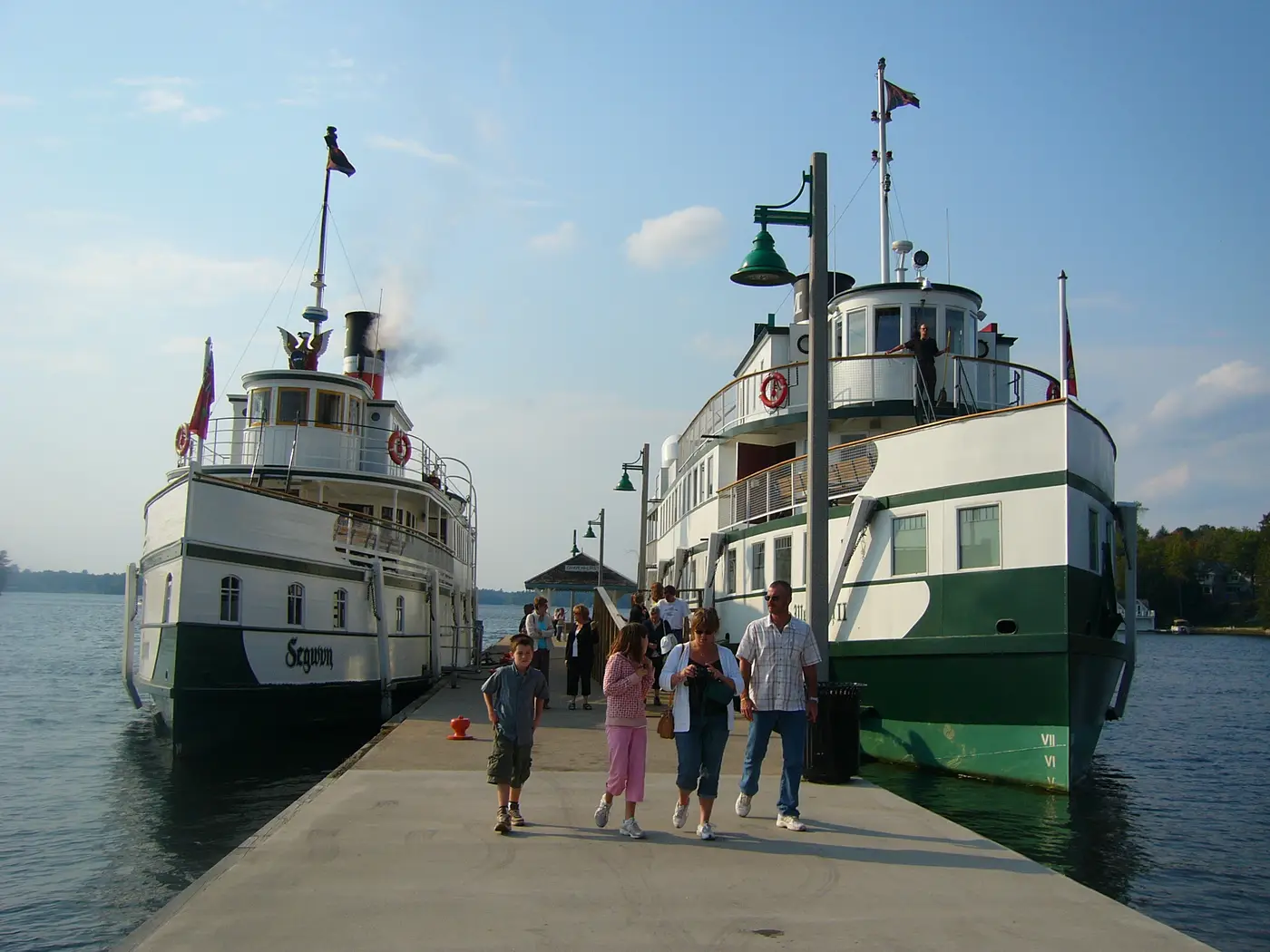
Two white steamships tied up at the Gravenhurst wharf, with people on the dock.
Segwun and a replica of the Wenonah at Gravenhurst, September 2008. Photo: Mathew Ingram / Wikimedia Commons, CC BY 2.0.

From the archive

1887

RMS Segwun

She was built in 1887 as the Nipissing. In 1925 she was rebuilt and renamed Segwun. She is the oldest operating steam-driven vessel in North America.

Sources: Wikipedia, RMS Segwun; Muskoka Discovery Centre

First peoples and the treaties

This was Anishinaabe territory long before the survey lines. The record is set down here as the sources give it.

Port Carling began as Obajewanung

Port Carling is the oldest community in Muskoka. It began as an Ojibwe settlement called Obajewanung, the gathering place. Europeans called it Indian Gardens.

Source: Township of Muskoka Lakes

See also: Events in Muskoka Lakes

1864

The name Muskoka

The name is generally traced to Chief Musquakie, also called William Yellowhead. He was an Ojibwe head chief and died at Rama in 1864. Historians note that other claims have been made.

Source: Dictionary of Canadian Biography

Who lived on Lake Joseph

The lake lies in the territory of the Anishinaabeg: Ojibwe, Odawa and Potawatomi. The Wendat lived to the south from about 1300 to 1650. The Collins purchase of 1785, the Robinson-Huron Treaty of 1850 and the Williams Treaties of 1923 all touch the area.

Source: Wikipedia, Lake Joseph

See also: Lake Joseph figures · Events in Muskoka Lakes

1881

The Wahta Mohawks arrive

In October 1881, Mohawk families came from Kanesatake: 70 adults and 63 children. Chiefs Joseph Onasakenrat and Louis Sahanatien led them. They were leaving persecution by the Sulpician missionaries. They called the new place Wahta, the place of sugar maples.

Source: Miskoaki

1868

Before the free grants

Before 1868, officials considered making all of Muskoka a reserve. The Free Grants and Homestead Act of 1868 opened the townships to settlers instead.

Source: Township of Muskoka Lakes

Steam and water

From 1866 to 1958 the steamers worked the lakes. They ran from the railhead at Gravenhurst to the head of navigation at Rosseau.

1866

The Wenonah, 1866

A.P. Cockburn put a small steamer on the Muskoka Lakes in 1866. It was the start of a navigation company. The company ran until September 1958.

Source: Muskoka Discovery Centre

1869

The Ditchburns

The Ditchburn brothers settled at Rosseau in 1869 and built boats there. In 1890 they moved the main works to Gravenhurst. Ditchburn’s Shoal, by the Rosseau lighthouse, keeps the name.

Source: Village of Rosseau guide (community history guide)

See also: Events in Gravenhurst · Events in Seguin

Roads, rails and mills

Settlers came by colonization road and then by train. The mills followed the water.

1864

The Rosseau–Nipissing Road

It was authorized in 1864 and surveyed by J.S. Dennis. Work began in 1866. It ran about 110 km north to the South River and Nipissing. By 1877 a stage ran the road three times a week. A provincial plaque by the Rosseau community hall marks the start.

Source: Village of Rosseau guide (community history guide)

See also: Events in Seguin

1894

A town that owned its power

Bracebridge became a town on Jan 1 1875. In 1894 it bought W.S. Shaw’s generating station for $3,500. It was the first municipality in Canada to own and operate a public utility.

Source: Town of Bracebridge

See also: Events in Bracebridge

1933

The line under the Seguin Trail

J.R. Booth built the Ottawa, Arnprior and Parry Sound Railway in the late 1800s. It carried Algonquin timber and western grain to Georgian Bay. A trestle washed out in Algonquin Park in 1933, and the trains stopped running past Seguin Falls. The rails came up in the mid-1950s. The trail is what is left.

Sources: Ontario Trails Council; Exploring Ontario

See also: Events in Seguin · Events in Parry Sound

Hotels and cottages

The resort era began at the head of Lake Rosseau. Some of the big hotels burned. One was built so it would not.

1870

Pratt’s Rosseau House

William and Lucy Pratt opened it at the head of Lake Rosseau in 1870. It is widely remembered as the first wilderness resort hotel in Canada. It burned on Oct 6 1883. It was never rebuilt.

Source: Village of Rosseau guide (community history guide)

See also: Lake Rosseau figures · Events in Seguin

1873

The Icelanders of Hekkla

In the summer of 1873 a party of 115 Icelanders reached Rosseau. They founded Hekkla, named for the volcano Hekla. The extra k was a postal error.

Source: Village of Rosseau guide (community history guide)

See also: Events in Seguin

The Muskoka chair

The chair began as Thomas Lee’s design in Westport, New York, between 1900 and 1903. In Canada it has been sold as the Muskoka chair since about the 1980s. It did not start here.

Source: Wikipedia, Adirondack chair

People and wartime

A painter, a surgeon, a novelist and an air force far from home.

1912

Tom Thomson

He came to Algonquin Park in May 1912. He rode the Ottawa, Arnprior and Parry Sound Railway to Canoe Lake Station, on the line the Seguin Trail follows now. He drowned on Canoe Lake in 1917. Winnie Trainor of Huntsville is often called his fiancée. That is disputed.

Sources: Wikipedia, Tom Thomson; The Globe and Mail

See also: Events in Huntsville · Events in Seguin

1890

Norman Bethune

He was born in Gravenhurst on March 4 1890. The house is now Bethune Memorial House National Historic Site, at 235 John St N.

Source: Parks Canada

See also: Events in Gravenhurst

1897

The Muskoka San

The sanitarium at Gravenhurst opened in 1897. It was the first TB sanitarium in Canada, the second in North America and the fourth in the world. The town put $10,000 toward it.

Source: National Sanitarium Association

See also: Events in Gravenhurst

Seguin, Rosseau and Parry Sound

North of the district line the lakes keep going. So does the history.

1998

How Seguin was formed

Seguin was made on Jan 1 1998. It joined Christie, Foley, Humphrey and the Village of Rosseau. It is the southernmost municipality in the District of Parry Sound. Its offices are in Humphrey.

Source: Wikipedia, Seguin

See also: Events in Seguin · Events in Parry Sound

1985

The Sled Dog Mail Run

It began in 1985. Teams carry mail about 17 km from Humphrey to Rosseau. The letters are hand-stamped at the end.

Source: Parry Sound Tourism

See also: Events in Seguin

1961

Two libraries

The Humphrey Public Library was established on April 13 1961. In 2002 the Christie branch moved into a new 2,000 sq ft library beside the new community centre just outside Orrville.

Source: Seguin Public Libraries

See also: Events in Seguin

The land

Rock, river, sky and the bird on the dollar.

The Canadian Shield

Muskoka’s granite and gneiss are part of it. It is some of the oldest exposed rock on Earth.

Source: Wikipedia, Canadian Shield

Glacial Lake Algonquin

About 10,000 years ago a glacial lake covered the area. It shaped the lakes we have now.

Source: Wikipedia, Lake Joseph

The Muskoka River

It rises in the Algonquin highlands and reaches Georgian Bay by the Moon and Musquash rivers. By average flow it is the third-largest river draining southern Ontario.

Source: Wikipedia, Muskoka River

1999

Torrance Barrens

It was set aside in June 1997. In 1999 it was recognised as the first permanent dark-sky preserve in Canada.

Source: Wikipedia, Torrance Barrens

1917

Big Chute

The marine railway at Lock 44 began in 1917 as a temporary fix. The railway there now dates from 1978.

Source: Parks Canada

The common loon

It is the provincial bird of Ontario. It is on the one-dollar coin.

Source: Wikipedia, Common loon